
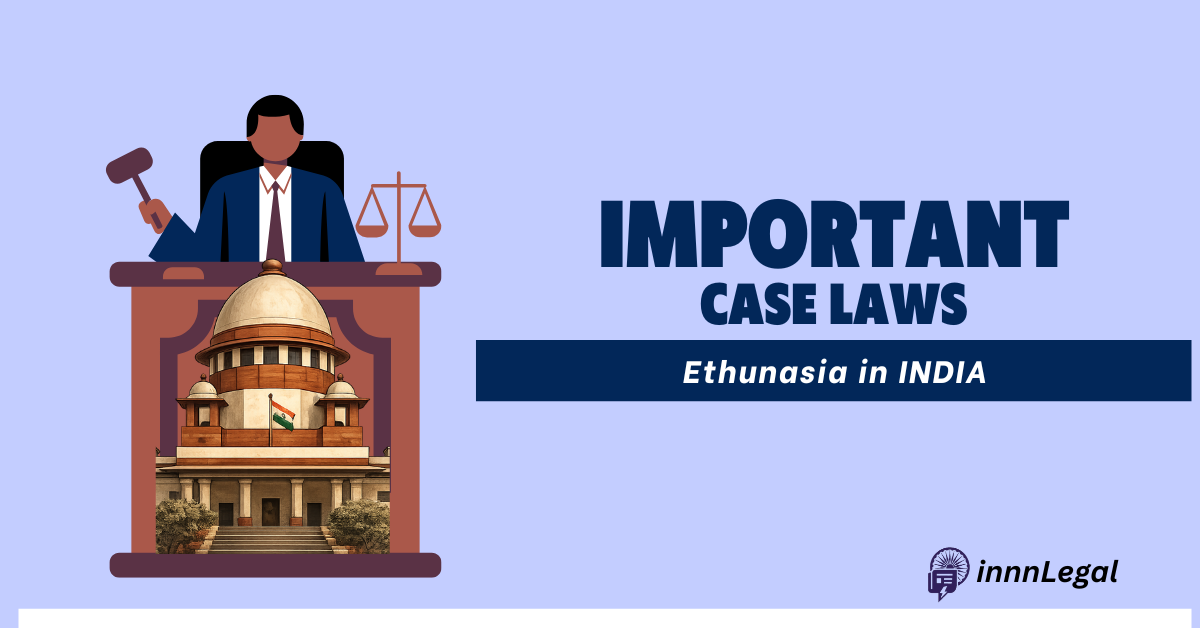
Euthanasia is not mentioned anywhere in the Indian Constitution. The right to live with dignity is guaranteed under Article 21, however the right to die is not specifically mentioned as a fundamental right. Consequently, discussions centred around the need to “die with dignity” as a basic right have reached the doors of the judiciary. Over time, the courts have dealt with this issue through several landmark judgments that shaped the legal position of euthanasia in India. Some of these landmark judgments are discussed below.
1. Gian Kaur v. State of Punjab(1996)
Facts of the case
In this case, the appellants Gian Kaur and her husband Harbans Singh were convicted by the Trial Court under Section 306 of the Indian Penal Code for abetting the suicide of Kulwant Kaur. They were each sentenced to six years’ rigorous imprisonment and a fine of ₹2,000, with an additional term of imprisonment in default of payment.
The appellants challenged their conviction before the High Court. The High Court upheld the conviction, but reduced the sentence of Gian Kaur to three years’ rigorous imprisonment. Dissatisfied with this decision, the appellants filed an appeal before the Supreme Court of India.
Issues Before the Court :-
- Whether the “right to die” is included within the “right to life” under Article 21 of the Constitution
- Whether Sections 306 and 309 of the Indian Penal Code are unconstitutional.
(earlier decision in P. Rathinam v. Union of India had held that the right to die is part of Article 21, and the Court in this case had to reconsider that interpretation.)
Judgment / Held :-
The Court observed that the right to life under Article 21 does not encompass the right to voluntarily end one’s life. The Court held that the sanctity of life should be preserved and that the state’s interest in protecting life outweighs an individual’s desire to end it. The Court recognised that suicide and attempted suicide were acts that needed intervention and that the law must serve as a deterrent, not to punish those in distress but to protect them and provide necessary help. Supreme Court also upheld the constitutionality of Section 306 of the IPC and dismissed the appellants’ appeal.
The judgement recognised the state’s role in protecting life and promoting public morality while also addressing the societal implications of suicide.
2. Aruna Shanbaug vs Union of India (2011)
Facts of the case
Aruna Shanbaug was a nurse working at King Edward Memorial Hospital. In 1973, she was brutally assaulted by a hospital ward boy, which caused severe brain damage and left her in a Persistent Vegetative State (PVS). She remained bedridden and dependent on others for care for several decades.In 2009, journalist and social activist Pinki Virani filed a writ petition before the Supreme Court of India seeking permission for passive euthanasia for Aruna Shanbaug, arguing that continuing life in such a condition violated her dignity.
The hospital staff at KEM Hospital, who had been caring for Aruna for many years, opposed the petition and stated that they were willing to continue taking care of her.
Issues Before the Court :-
- Whether euthanasia could be permitted under Indian law ,this was first formal differentiation between passive and active euthanasia in India
- Who is entitled to make a decision on behalf of an incompetent patient
- What procedural safeguards (and also procedure) are required to prevent abuse if passive euthanasia is allowed ( Consent v. Safeguards)
- Whether the continuing artificial feeding of Aruna Shanbaug, who is in a permanent vegetative state, can lawfully be withdrawn
Judgement / Held :-
The Supreme Court of India rejected the plea filed by Pinki Virani seeking permission for passive euthanasia for Aruna Shanbaug. The Court held that the withdrawal of life support was not justified in the present case, particularly because the staff of King Edward Memorial Hospital, who had been caring for her for many years, opposed the request and were willing to continue her treatment, but this judgment had a broader results ,for the first time, the Supreme Court recognised the permissibility of passive euthanasia in India. The judgment also signals potential legislative reform of IPC § 309. The Court also clarified that active euthanasia remains illegal in India, while passive euthanasia may be allowed under strict safeguards and judicial supervision.( Later developments in cases such as Harish Rana v. Union of India applied and expanded these principles, permitting withdrawal of life-sustaining treatment when medical boards confirmed that recovery was impossible.)
3. Alpana Bhartia v. State of Karnataka (2015)
(Animal ethunasia case)
Facts of the Case
The petitioners were the founder trustees of “People for Animals” (PFA), a registered public charitable trust established in 1998 to promote animal rights and welfare. As part of their activities, they rescued and protected 80 black kites. Out of these, 20 black kites became seriously infected. The petitioners provided medical treatment through veterinary doctors, but the birds did not recover. On the advice of a veterinary doctor, the petitioners carried out euthanasia (mercy killing) on the 20 infected birds to prevent further suffering.
A complaint was later filed alleging that the petitioners had committed an offence under Section 51 of the Wild Life (Protection) Act, 1972. The Government, after examining the circumstances, concluded that the petitioners had no criminal intention (mens rea) and that the prosecution would serve no useful purpose. Therefore, the Public Prosecutor filed an application under Section 321 CrPC seeking permission from the court to withdraw the prosecution.
However, the trial court rejected this application, leading the petitioners to approach the High Court.
Judgment / Held : –
The High Court held that the petitioners acted in good faith for animal welfare and had no mens rea in euthanizing the infected black kites, as it was done on veterinary advice. The court observed that the birds were not kept for commercial exploitation and that continuing prosecution would serve no useful public purpose. Therefore, the High Court set aside the Magistrate’s orders and allowed the withdrawal of prosecution under Section 321 CrPC.
4. Common Cause v. Union of India (2014 & 2018)
Facts of the Case
The NGO Common Cause(a society registered under the Societies Registration Act, 1860) filed a Public Interest Litigation (PIL) seeking legal recognition of “Living Wills” and the right of terminally ill patients to refuse life-sustaining medical treatment. Receiving no reply, the society invoked Article 32 of the Constitution and filed the present writ petition. The petition gained momentum after the Aruna Shanbaug case (2011), which had allowed passive euthanasia under strict judicial guidelines but left the matter open for legislative clarity.
Issues Before the Court :-
- Does Article 21 (Right to Life) include the Right to Die with Dignity?
- Are living wills valid? (at what extent )
- Legislative versus judicial role in regulating passive euthanasia
- Conflicting decision of previous cases ( i.e :- Aruna Shanbaug vs Union of India ,2011 , Gian Kaur v. State of Punjab,1996 )
Judgment/Held – Common Cause v. Union of India (2014)
In the 2014 decision, the Supreme Court of India did not finally decide the issue of euthanasia. The Court observed that the matter involved important constitutional questions regarding the right to die with dignity under Article 21. Therefore, the case was referred to a Constitution Bench for authoritative determination.
Judgment /Held – Common Cause v. Union of India (2018)
The Supreme Court of India held that passive euthanasia and legally executed Advance Medical Directives (Living Wills) are constitutionally valid under Article 21, as part of the right to life with dignity. The Court ruled that a person has the right to refuse life-sustaining treatment and to decide in advance the manner of medical care at the end of life.
The Court further held that terminally ill patients or persons in a permanent vegetative state may have life-support withdrawn or withheld, provided that the procedural safeguards and medical board approvals laid down by the Court are followed. It also clarified that doctors acting in accordance with these safeguards would not incur criminal liability.
Importantly, the Court overruled the earlier view in Aruna Ramchandra Shanbaug v. Union of India to the extent that it required High Court approval, and simplified the procedure for withdrawal of life support.
The Court stated that these guidelines would operate as binding law until Parliament enacts comprehensive legislation on end-of-life decisions. The judgment also strengthened constitutional principles relating to dignity, privacy, bodily autonomy, and the right to die with dignity.
5. Allarakha Ismailbhai Thimmar v. Union of India (2022)
Facts of the case
This case concerns two writ petitions filed before the Gujarat High Court, wherein the petitioners seek permission to commit mass euthanasia. The petitioner presenting the Gosabra Muslim Machhimar Samaj Community (approx. 600 in number), alleges continuous harassment by state authorities who have prohibited them from parking their boats and have refused to grant parking licenses since 2016. Due to this alleged maltreatment, the petitioner and his community submitted a written application on 31.03.2022 to various high-ranking state officials seeking permission for collective euthanasia. The request, however, appears to have been made more as an expression of extreme anguish and protest rather than a genuine desire to end their lives.
Issues Before the Court :-
- Whether euthanasia can be granted for reasons other than medical conditions
- Whether the Birth and Death Registration laws can be invoked to seek euthanasia
- Whether filing such petitions amounts to abuse of judicial process
- Professional responsibility of advocates
Judgement/Held :-
The Gujarat High Court dismissed both writ petitions seeking permission to commit euthanasia. The Court held that euthanasia can only be permitted in limited circumstances such as when a person is suffering from a terminal illness or is in a permanent vegetative state, as laid down in Common Cause v. Union of India. Both the petitions were found to be misconceived and frivolous and was dismissed. It also criticized the advocate for filing such petitions instead of guiding the petitioners toward appropriate legal remedies. Consequently, both writ petitions were rejected, and a cost of ₹5,000 was imposed on the advocate in each petition for filing frivolous petitions that wasted the Court’s time.
6. Harish Rana v. UOI 2024
In this case, Harish Rana suffered a severe brain injury after falling from the fourth floor of his paying-guest accommodation. The accident left him in a Persistent Vegetative State (PVS), and he remained completely paralysed with no signs of recovery for more than thirteen years. He survived only through clinically administered nutrition provided through feeding tubes. a writ petition seeking the constitution of a Medical Board to consider passive euthanasia was dismissed, as the Court held that the petitioner was not terminally ill or on mechanical life support, and therefore did not qualify for passive euthanasia under the existing legal framework. The Court also reiterated that active euthanasia is impermissible and that passive euthanasia requires strict procedural safeguards and judicial approval.
Due to the irreversible condition, Harish Rana’s father approached the Supreme Court of India seeking permission to withdraw life-sustaining treatment.
Issues Before the Court :-
- Scope of Ethunasia in India (Active and Passive)
- Legality of Passive ethunasia
- Fundamental right in question (Article 21)
Judgement :- (Final judgement on 11th march ,2026)
The Supreme Court of India reversed the earlier decision that had denied permission for passive euthanasia and allowed the petition filed by Harish Rana’s father. The Court permitted the withdrawal of life-sustaining treatment, including clinically administered nutrition, after medical boards confirmed that the patient had no meaningful chance of recovery.
The Court held that clinically administered nutrition is a form of medical treatment and may be withdrawn when it serves no therapeutic purpose. It also directed that the patient be shifted to AIIMS for palliative care, where the withdrawal of treatment would be carried out under proper medical supervision while ensuring the patient’s dignity. The Court reaffirmed that passive euthanasia is permissible under Article 21 (right to die with dignity), while active euthanasia remains illegal
What was the issue in Common Cause v UOI?
legally valid and whether the right to die with dignity is part of Article 21.
Is euthanasia legal in India?
Active euthanasia remains illegal in India, but passive euthanasia is permitted under strict guidelines.
What is a living will?
A living will is a written document in which a person states that life-support treatment should not be continued if they become terminally ill.

1st year law student ,Pursuing BA LLB from FACULTY OF LAW BHU
Law student and legal writer focusing on constitutional law and landmark judicial decisions. He also explores technology, AI, and web development to improve legal research and digital legal publishing.
Related posts:
 Practical Insights for Law Students: Skills, Strategy, and Career Building
 Electoral Bonds Declared Unconstitutional by Supreme Court: Verdict, Article 19(1)(a) & major impact on Indian Democracy
 Important Judgements on Domestic Violence: Indian Courts on Protection, Residence & Abuse of Women .
 Understanding Vakalatnama : The Ultimate Guide for Law Students (2026)
 Admissibility of Brain Data as Evidence: A Constitutional and Evidentiary Analysis in the Age of Neurotechnology
 7 Hidden Legal Websites Every Law Student Must Bookmark !