
The Faculty of Law at Banaras Hindu University is one of the oldest and most reputed law schools in India. Established in 1924, also known as “Judge Factory”, not just for its reputation but for its remarkable legacy and consistent success in judicial service examinations, as well as producing some of the countries best lawyers. Building upon this legacy, the Faculty of Law offers a range of academic programmes designed to students with comprehensive legal knowledge and skills. These include the five-year integrated BA LL.B. (Hons.) programme, the three-year LL.B. course, LL.M., and doctoral research programmes, providing students with diverse pathways to pursue careers in litigation, judiciary, academia, and public policy.
In this article we will specifically discuss about the BA LLB(Hons) also known as 5 year-Law Program.
About The Course
The BA LL.B. (Hons.) programme at the Faculty of Law, Banaras Hindu University was introduced in 2014 as a five-year integrated undergraduate law course as an undergraduate program (BCI Legal Education Rules 2008). The programme consist of disciplines from the arts and social sciences, such as Political Science, Sociology, and Economics, with gradually shifting focus on core legal subjects like Tort Law, Constitutional Law, Criminal Law, Contract Law, and Administrative Law etc .
Previously, admission to the BA LL.B. (Hons.) programme was conducted through the Banaras Hindu University Undergraduate Entrance Test, which was organised directly by Banaras Hindu University for undergraduate programmes. However, from 2022 onwards, the admission process have been shifted to the Common University Entrance Test (CUET-UG), conducted by the National Testing Agency. Under this system, candidates seeking admission to the BA LL.B. (Hons.) programme must appear for CUET-UG and secure the required score to get seat in the university.
The BA LL.B. (Hons.) programme is divided into ten semesters over five years (each year containing 2 semester’s), with 1 month of summer break (internship break). Syllabus is strictly according to the official syllabus of Bar-Council .
Why BHU Law is a Popular Choice for Students ?
There are many reasons why students choose BHU (Faculty of Law):
- Strong Alumni base
BHU’s Faculty of Law has alumni base is one of the strongest in India such as Ravi Shankar Prasad and Satya Pal Malik. - Affordable Education
Being a government-funded institution, tuition fees are significantly lower compared to private law schools. Faculty Of Law BHU offers a world-class education at a fraction of the cost (will detail about this in the later part of the article ). - Campus & Student Life
Being largest residential university in Asia , the campus of Banaras Hindu University provides vibrant extracurricular opportunities. Students can participate in various sports such as swimming, badminton, football, cricket, and hockey. The university also encourages participation in cultural and social clubs, including music, dance, martial arts, and the National Service Scheme (NSS), enabling students to develop both physical and leadership skills alongside their legal education. - Academic Rigor & Opportunities (NIRF 2024 (Law category): Rank 25 in India)
Students benefit from opportunities such as moot courts, seminars, research activities, and internships, which help bridge the gap between theoretical learning and practical legal experience.
Admission, Eligibility , CUET Cut-Off and Seat Matrix for BHU BA LL.B (Hons) 2026
Admission to the Faculty of Law, Banaras Hindu University is granted strictly on merit based on the candidate’s Common University Entrance Test (CUET-UG) score
Subjects in which you should appear to be eligible for the BA LLB course are as follows
| Subjects | Subject Code |
| Any Language Subject (Eng ,Hindi etc ) | – |
| GAT | 501 |
Each subject is of 250 marks (+ 5 for correct answer , – 1 for each wrong answer , in total 50 questions )
Cut-off trend
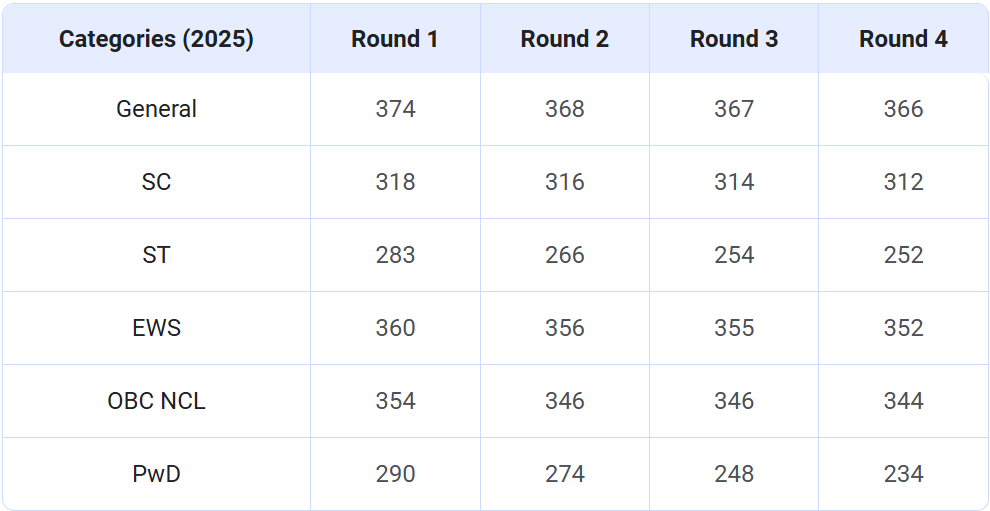
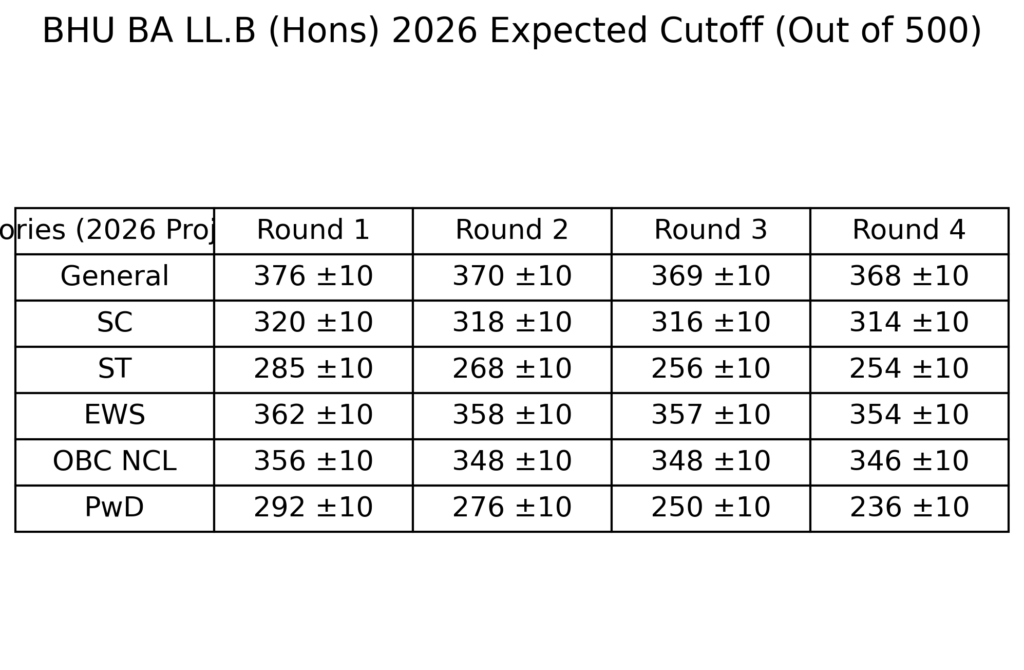
The cutoff for BHU BA LL.B (Hons) changes every year depending on factors such as the number of applicants, difficulty level of the exam, and overall performance of candidates. It is important to note that before 2025, CUET considered three subjects—Language, General Test (GAT), and Legal Studies—for admission. However, from 2025 onwards, Legal Studies has been removed, and only two subjects (Language and GAT) are considered for merit preparation. Due to this change in the subject combination, previous years’ cutoff trends may not accurately predict the cutoff for upcoming admissions.
The following represents the 2025 cutoff (out of 500 marks). However, the cutoff for the BHU Warden Quota is not released centrally and is determined separately at the college level.
Seat Matrix
The number of seats in the BA LL.B (Hons) programme at the Faculty of Law, Banaras Hindu University may vary each year depending on factors such as available accommodation and university capacity. Therefore, the seat intake is not always fixed.
For instance, the total number of seats has changed in recent years. In 2024, the programme had 90 seats, while in 2025 the intake increased to 104 seats. Generally, the number of seats tends to range between 90 and 110 seats per year (±5).
Fee Structure
The annual tuition fee is relatively moderate compared to private institutions, making it affordable for aspiring law students. Additional expenses include hostel charges, mess fees, examination fees, and minimal administrative costs. This combination of reasonable fees and scholarship opportunities makes BHU a highly accessible choice for aspiring lawyers seeking both excellence and affordability.
| Total Fees (5 Years) | 3.7 lakhs (36k-37k per sem) |
| Hostel Charges | 300-400/month(5-6k per year) |
| Mess charges | 3000/per month |
Who Should Choose BHU BA LLB
The B.A. LL.B (Hons.) program offered by the Faculty of Law, Banaras Hindu University is a strong choice for students seeking a solid foundation in legal education at one of India’s most prestigious public universities. Being part of Banaras Hindu University, the program carries significant reputation and place value, with a long legacy of producing judges, advocates, civil servants, and legal scholars. The academic environment emphasizes conceptual clarity and deep understanding of law rather than only focusing on corporate placements.
However, students should also be aware that BHU is a very old and traditional institution, and like many large public universities, modernization can be relatively slow compared to private law schools.
Consider BHU BA LL.B if you:
- Prefer strong academic foundations and theoretical understanding of law.
- Are interested in judiciary preparation, litigation, or government legal services.
- Value the legacy, alumni network, and reputation of a historic institution.
- Want a high-quality legal education at an affordable cost.
Possible Drawbacks to Consider
- Old infrastructure in some parts of the campus.
- Traditional teaching methods compared to modern private law schools.
- Limited exposure to corporate law culture relative to private universities.
- No High Court in Varanasi, which may limit certain litigation exposure.
- Being part of a very large university, administrative processes can sometimes be slow.
Overall, BHU Law is particularly suitable for students who want strong legal knowledge, preparation for judiciary or litigation, and a prestigious public university background, even if placements and corporate exposure are not the primary focus.
-
What is the CUET cutoff of BHU BA LLB
CUET score varies each year depending on the cut-off, competition, and number of applicants.
-
How many seats are available in BHU BA LL.B (Hons)?
The number of seats varies slightly each year. In recent years, the intake has ranged between 90 and 110 seats, depending on university capacity.
-
Is BHU BA LLB good for law studies?
Yes, the Faculty of Law, Banaras Hindu University is one of the oldest law schools in India and is known for its academic rigor, experienced faculty, and strong alumni network.

1st year law student ,Pursuing BA LLB from FACULTY OF LAW BHU
Law student and legal writer focusing on constitutional law and landmark judicial decisions. He also explores technology, AI, and web development to improve legal research and digital legal publishing.